Washington
Every week, Rajesh PN Rao, a computer scientist, gets emails from people claiming they’ve cracked an ancient script that has stumped scholars for generations.
These self-proclaimed codebreakers – ranging from engineers and IT workers to retirees and tax officers – are mostly from India or of Indian origin living abroad. All of them are convinced they’ve deciphered the script of the Indus Valley Civilisation, a blend of signs and symbols.
“They claim they’ve solved it and that the ‘case is closed’,” says Mr Rao, Hwang Endowed Professor at the University of Washington and author of peer-reviewed studies on the Indus script.
Adding fuel to the race, MK Stalin, the chief minister of southern India’s Tamil Nadu state, recently upped the stakes, announcing a $1m prize for anyone who can crack the code.
The Indus, or Harappan, civilisation – one of the world’s earliest urban societies – emerged 5,300 years ago in present-day northwest India and Pakistan. Its austere farmers and traders, living in walled, baked-brick cities, thrived for centuries. Since its discovery a century ago, around 2,000 sites have been uncovered across the region.
The reasons behind the society’s sudden decline remain unclear, with no apparent evidence of war, famine or a natural disaster. But its greatest mystery is its undeciphered script, leaving its language, governance and beliefs shrouded in secrecy.
For over a century, experts – linguists, scientists and archaeologists – have tried to crack the Indus script. Theories have linked it to early Brahmi scripts, Dravidian and Indo-Aryan languages, Sumerian, and even claimed it’s just made up of political or religious symbols.
Yet, its secrets remain locked away. “The Indus script is perhaps the most important system of writing that is undeciphered,” says Asko Parpola, a leading Indologist.
These days, the more popular spectacular theories equate the script with content from Hindu scriptures and attribute spiritual and magical meanings to the inscriptions.
Most of these attempts ignore that the script, made up of signs and symbols, mostly appears on stone seals used for trade and commerce, making it unlikely they contain religious or mythological content, according to Mr Rao.
There are many challenges to deciphering the Indus script.
First, the relatively small number of scripts – about 4,000 of them, almost all on small objects such as seals, pottery and tablets.
Then there’s the brevity of each script – average length of about five signs or symbols – with no long texts on walls, tablets or upright stone slabs.
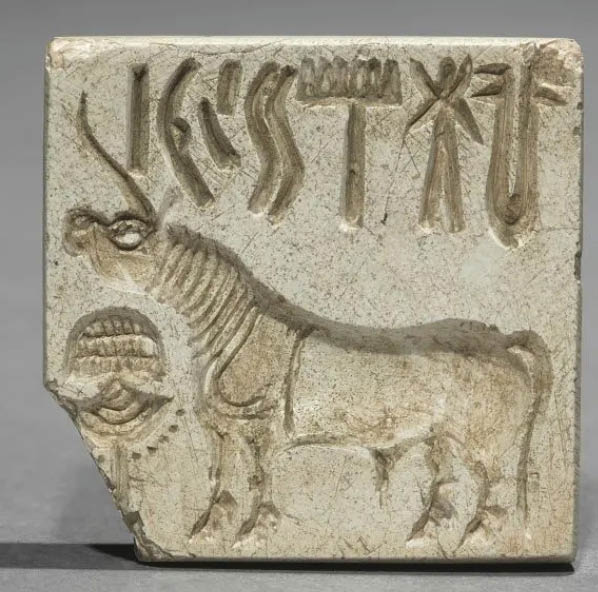
Consider the commonly found square seals: lines of signs run along their top, with a central animal motif – often a unicorn – and an object beside it, whose meaning remains unknown.
There’s also no bilingual artefact like the Rosetta Stone, which helped scholars decode Egyptian hieroglyphs. Such artefacts contain text in two languages, offering a direct comparison between a known and unknown script.
Recent advancements in deciphering the Indus script have used computer science to tackle this ancient enigma. Researchers have used machine learning techniques to analyse the script, trying to identify patterns and structures that could lead to its understanding.
Nisha Yadav, a researcher at the Mumbai-based Tata Institute of Fundamental Research (TIFR), is one of them. In collaboration with scientists like Mr Rao, her work has focused on applying statistical and computational methods to analyse the undeciphered script.
Using a digitised data set of Indus signs from the script, they have found interesting patterns. A caveat: “We still don’t know whether the signs are complete words, or part of words or part of sentences,” says Ms Yadav.