DLP Report
PESHAWAR
Khyber Pakhtunkhwa Adviser on Law and Parliamentary Affairs Aamir Javed has called for the enforcement of the “polluter pays” principle to ensure that industries and businesses bear the full cost of environmental damage caused by their activities.
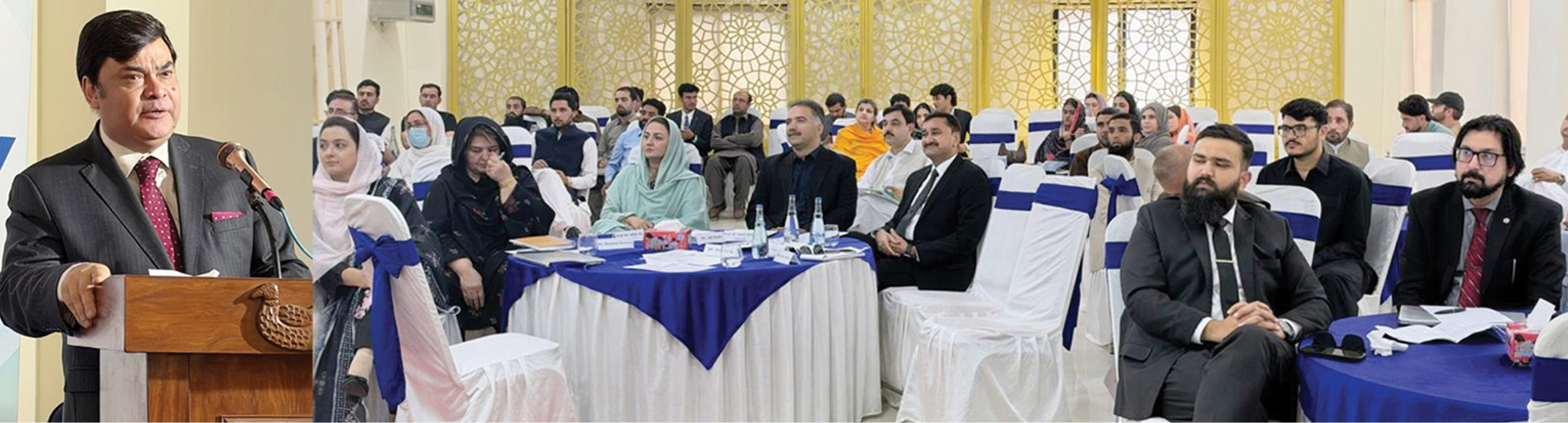
He was speaking as chief guest at a one-day workshop titled “Academia Advocacy on Environmental Justice” at the University of Peshawar. The event was jointly organised by the Directorate General of Law and Human Rights, KP, the university’s Institute of Peace and Conflict Studies, and UNDP Pakistan under the Rights of Pakistan Phase-II project.
The workshop was attended by Director General of Law and Human Rights Ghulam Ali, Dr Jamil Chitrali of the Institute of Peace and Conflict Studies, UNDP Provincial Human Rights Officer Adil Bashir, academics, students and civil society representatives.
In his opening remarks, Mr Ghulam Ali highlighted the department’s initiatives to protect human rights and strengthen institutional coordination. Dr Chitrali emphasised the role of academia in research, policymaking and shaping public opinion on environmental justice, while Mr Bashir reaffirmed UNDP’s commitment to supporting the provincial government in promoting human rights and environmental justice. Mr Javed appreciated the organisers for providing a platform to link environmental protection with human rights. He said the right to a clean, healthy and sustainable environment was essential for the enjoyment of other fundamental rights, including the rights to life, health and livelihood.
He expressed concern over the environmental challenges facing the province, including climate change, floods, deforestation, pollution and mounting pressure on water resources. He called for coordinated action, strict enforcement of environmental laws and greater public awareness to address these challenges. The law adviser stressed that the costs of environmental damage should be incorporated into commercial and industrial operations. He said businesses should not be allowed to shift the hidden costs of pollution, health hazards and environmental degradation onto local communities and the public exchequer.
He said the “polluter pays” principle must be implemented through legal and commercial frameworks to ensure that businesses take full responsibility for the environmental consequences of their activities.
Mr Javed assured the participants that the provincial government would extend support to academia, relevant departments and international development partners in addressing environmental justice and human rights challenges.
He urged the participants to propose practical measures to improve access to environmental justice, particularly for disadvantaged and vulnerable communities.
Later, the adviser distributed commemorative shields among participants, speakers and organisers in recognition of their contributions.