GR Junejo
Tharparkar
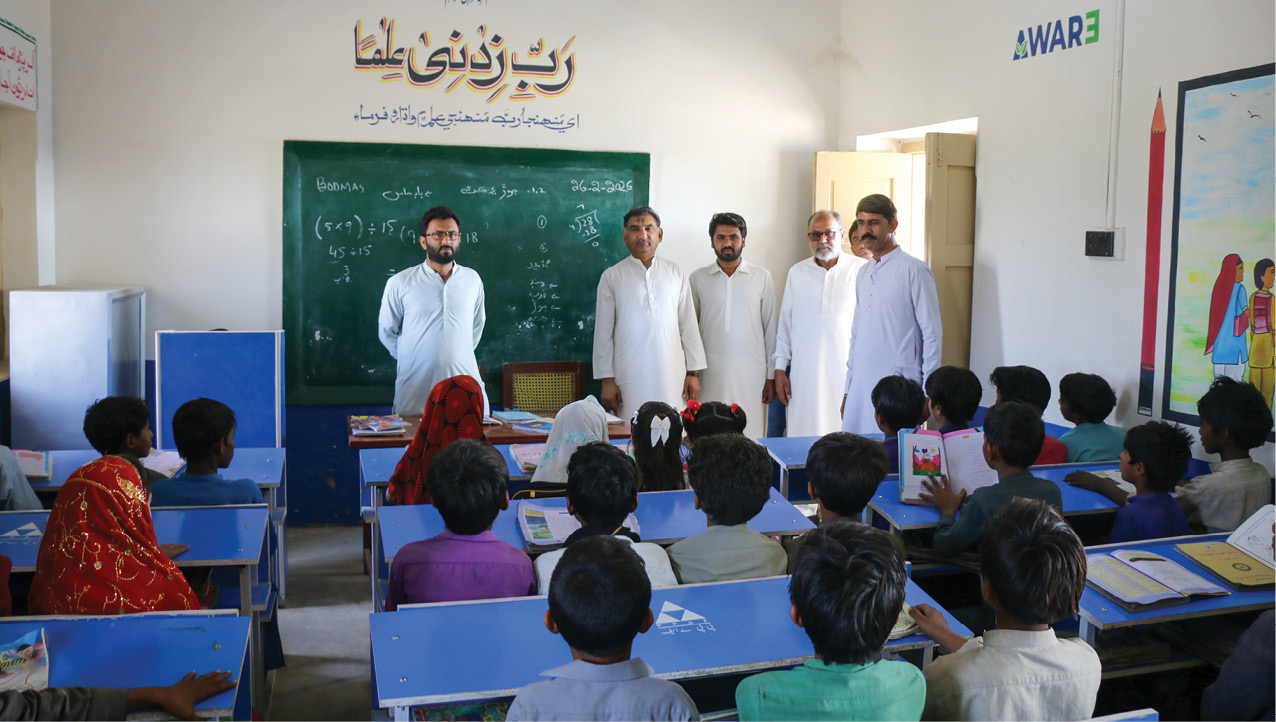
A major infrastructure retrofitting initiative has transformed five flood-damaged schools in District Umerkot, Sindh, into climate-resilient learning hubs, restoring safe access to education for rural communities severely impacted by the catastrophic 2022 monsoon floods. Executed by the Association for Water, Applied Education and Renewable Energy (AWARE) and funded by the Pakistan Poverty Alleviation Fund (PPAF) under the “Restoring Social Services and Climate Resilience” (RSS&CR) project, the initiative has directly benefited 9,295 residents across 1,314 rural households in Union Councils K.S. Atta Muhammad Palli and Sabho/Koonjheli.
Prior to the intervention, these rural educational facilities suffered from collapsing T-iron roofs, crumbling masonry, complete electrical grid failures, missing boundary walls, and a severe lack of clean drinking water and sanitation facilities.
These deteriorating conditions significantly drove up dropout rates, particularly among young girls due to dignity and hygiene concerns surrounding open defecation.
To address these challenges, the project delivered comprehensive structural overhauls across the five campuses—GHS Babu Faqeer, GBPS Essa Mangrio, GBPS Gull Mohammad Palli, GBPS Khabar Bheel, and GBPS Mohammad Saleh Palli—including complete roof repairs, weather-shield painting, new classroom additions, and solid perimeter boundary walls with iron gates to secure grounds against livestock intrusion and safety hazards.
The upgrades have driven significant social and environmental impacts, boosting total student enrollment across the five facilities by 19.07%—rising from 514 to 612 students—while female student retention saw a notable 27.88% surge, growing from 208 to 266 girls.
To ensure long-term resilience against frequent local climate shocks, the campuses were equipped with 11.55 kW of total off-grid solar PV capacity to provide uninterrupted power for lighting, fans, and water pumps.
Water and sanitation infrastructure was overhauled through the construction of 14 twin-latrine blocks elevated 1–3 feet above historical flood levels, paired with solar pumps and a 6-stage 200 GPD Reverse Osmosis (RO) filtration plant.
Additionally, 1,500 native trees were planted across school grounds to mitigate extreme summer heatwaves and prevent soil erosion, contributing an estimated 10.46 tons of annual carbon dioxide abatement.
Local educators and community representatives confirmed that restoring perimeter security, clean drinking water, and private sanitation facilities has rebuilt institutional dignity and community trust, ensuring a secure environment for continuous learning.