Economy must be expanded to $ 1 trillion for public welfare: Mian Zahid Hussain
Our Correspondent
Islamabad
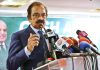
The Chairman of National Business Group Pakistan, the President of the Pakistan Businessmen and Intellectuals Forum, the President of All Karachi Industrial Alliance, the Chairman of the FPCCI Advisory Board, and the former provincial minister, Mian Zahid Hussain, said on Friday that the current economic growth rate is inadequate to meet the country’s defence and public welfare needs.
He stressed that an increase in Pakistan’s defence budget has become inevitable in the face of a cunning adversary like India, which spends ten times more on defence.
Mian Zahid Hussain highlighted the need to expand Pakistan’s economy to USD 1 trillion annually, as declared by Prime Minister Shahbaz Sharif. This is in contrast to the current economic size of only $411 billion in the ongoing fiscal year.
Talking to the business community, the veteran business leader said that industrial development is essential to provide public relief and create jobs. However, the economic growth rate is expected to fall short of the target, likely ending at just 2.6%, which is alarming for a country where 70% of the population comprises youth.
He noted that such low growth makes it impossible to generate sufficient employment opportunities, which will only worsen unemployment, poverty, and inflation.
Mian Zahid Hussain urged the government to take immediate and comprehensive measures to stabilize the economy and ensure a consistent increase in the growth rate. He identified poor performance in the agriculture and industrial sectors as major contributors to economic stagnation. Furthermore, he warned that Pakistan’s high interest rates are obstructing industrial productivity. Lowering energy costs and reducing interest rates are critical to decreasing production expenses and restoring investor confidence.
He stressed the importance of adopting fresh, practical economic policies instead of repeating outdated and failed strategies. These new policies should focus on increasing both the overall size of the economy and the growth rate. He warned that if the economic trajectory is not corrected, the country’s sovereignty could be at risk.
He also reiterated that sustainable development requires strengthening both defence and the economy, as a weak economy is the biggest obstacle to national sovereignty, stability, and public welfare.
He advocated facilitating the private sector to stimulate investment, increasing exports, substituting imports, and reducing the trade deficit. He called for redirecting all national resources, policies, and energies toward export promotion.
Furthermore, he emphasized the urgency of curbing the wastage of national resources and strengthening the productive sectors. A simplified, fair, and transparent tax system, backed by complete digitalization of all transactions, is vital to restoring economic confidence. Lastly, he underlined the importance of equipping the youth with skills to ensure employment and economic participation.