DLP Report
PESHAWAR
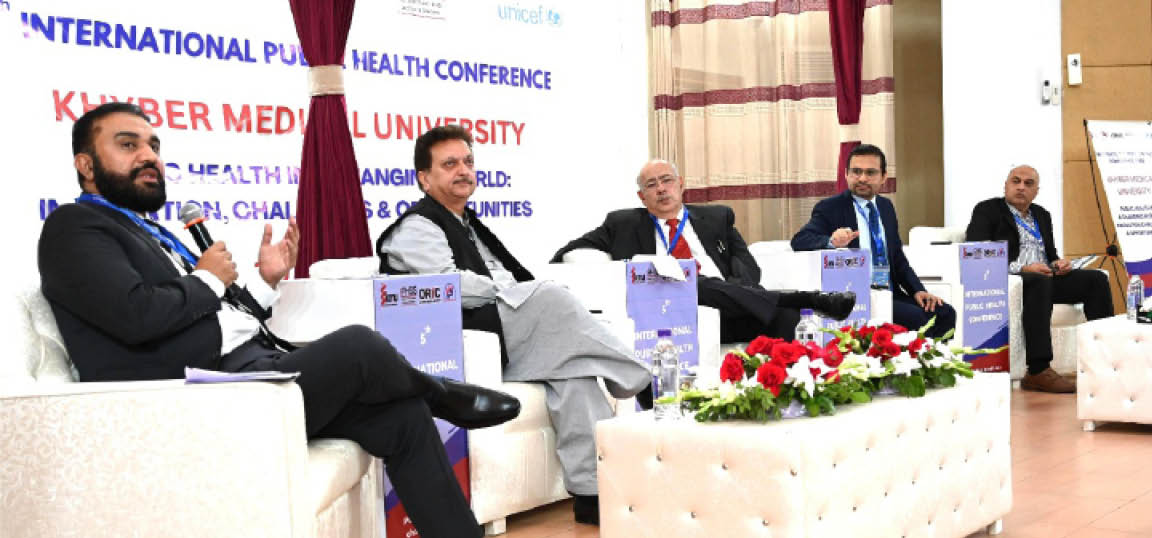
Khyber Medical University (KMU) proudly inaugurated the 5th International Public Health Conference on April 9, 2025. The event brought together leading public health experts, clinicians, researchers, and policymakers from across Pakistan and abroad to deliberate on critical health challenges facing the region and the world. Day 1 of the conference centered on two pivotal themes: Non-Communicable Diseases (NCDs) and the Climate Change & Health Nexus, emphasizing the need for integrated and interdisciplinary strategies in public health.
The conference opened with a dynamic plenary session on Non-Communicable Diseases. Professor Dr. Zia ul Haq, Vice Chancellor of KMU, delivered a compelling keynote on “The Role of Lifestyle Medicine in Handling the Pandemic of NCDs.” He stressed that the global burden of NCDs can no longer be managed without prioritizing prevention through behavior change, community-level interventions, and a shift in medical education toward lifestyle medicine. Following this, Professor Abdul Jalil Khan, Director of Family Medicine at KMU and a physician with extensive experience in the United Kingdom, presented “Bridging the Gaps: Insights from the UK for Tackling NCDs Globally.”
He urged adaptation of scalable primary healthcare models that are sensitive to the needs of low- and middle-income countries. Dr. Munaira Abbasi, a triple board-certified U.S.-based physician, spoke on “Combating NCDs: The Role of Lifestyle Medicine in Public Health.” She emphasized the urgent need for clinicians to adopt a preventive and holistic approach, highlighting how clinical care must intersect with public health initiatives to combat rising NCD trends.
A thought-provoking panel discussion followed, featuring Dr. Bilal Imtiaz from UNICEF Headquarters, Dr. Fawad Khan of WHO Sudan, Dr. Muhammad Khalil Akhtar from KP’s Health Sector Reforms Unit, and Professor Dr. Zia ul Haq. The panel collectively identified the urgent need to scale up NCD prevention efforts through multisectoral approaches. Dr. Imtiaz emphasized adolescent health and early intervention as essential to halting the generational cycle of NCDs. Dr. Khan discussed the overlooked burden of NCDs in humanitarian crises and fragile states, where chronic disease care often collapses. Dr. Khalil Akhtar highlighted KP’s efforts in developing integrated care pathways and strengthening provincial surveillance systems, while Dr. Zia ul Haq reiterated the importance of political will and policy coherence across sectors. Findings shared during this session noted that over 60% of Pakistan’s disease burden stems from NCDs and that interventions such as digital health tools, lifestyle education, and early diagnosis remain underutilized.
The afternoon session shifted focus to the Climate Change and Health Nexus, with keynote speaker Dr. Jai Das, Associate Professor at Aga Khan University, delivering a compelling presentation titled “The Climate-Health Nexus: Impact, Shaping Adaptation and Resilience.” Dr. Das underscored the compounding impact of climate change on vulnerable populations, including women, children, and the urban poor. He called for integrated national policies that address environmental sustainability and public health in tandem, warning that failure to act now would undo decades of public health progress.
Dr. Maria Ishaq Khattak, Assistant Professor and Head of the Department of Dental Public Health at KMU, presented her research on “Understanding Climate Change and Health Vulnerability: Socio-Economic Incentives for Climate Resilience Among Informal Sector Workers in Khyber Pakhtunkhwa.”