Washington, D.C.
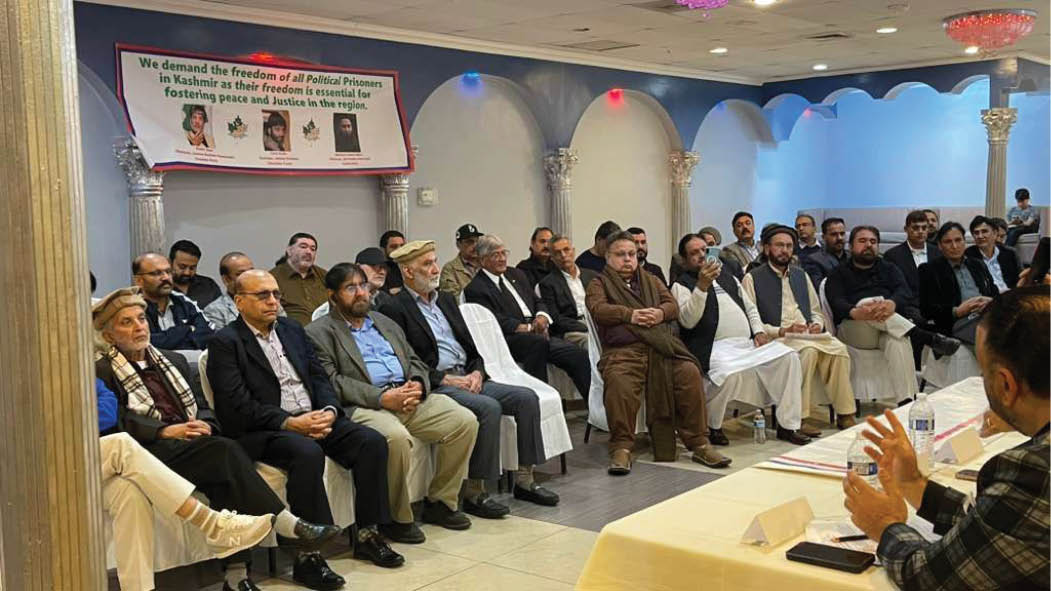
An impressive and well-attended seminar entitled, “The tragedy of October 27 when Kashmir was occupied” was organized by ‘World Kashmir Awareness Forum’ in Springfield, Virginia to highlight the Kashmir issue, commemorating October 27 — the day in 1947 when Indian troops entered the region.
Speakers from various backgrounds, including academics, human rights advocates, media fraternity and members of the Kashmiri and Pakistani diaspora, shared their perspectives on the historical and political dimensions of the conflict.
The event emphasized the ongoing humanitarian concerns in the region and called for renewed international attention toward a peaceful and just resolution of the dispute.
The event began with the recitation of al-Quran by 8 years old Anas Rahman and Salawaat-e-Rasul by Javaid Kousar, a well-known journalist in the metropolitan community.
Sardar Zarif Khan, Advisor to the President of Azad Kashmir welcomed the participants and explained the purpose of the seminar, outlining its aim to raise awareness about the historical context of the Kashmir issue and to encourage dialogue on possible paths toward peace between India, Pakistan and the leadership of the people of Kashmir.
Dr. Ghulam N. Mir, President of World Kashmir Awareness Forum said that October 27, 1947, was one of the most tragic events in the national history of Jammu and Kashmir.
Prior to the overt invasion, India undertook covert reconnaissance missions deep into Kashmir followed by the genocidal mission called the Jammu Genocide in which over 237,000 Muslims were slaughtered, mainly in the Jammu province.
Over half a million Muslims were forced into what is now Sialkot in Pakistani Punjab. This mass murder was carried out by the Patiala Sikh regiment of India and paramilitary gangs of RSS, armed and abetted by the forces of Maharaja Hari Singh.
Since then, the people of Kashmir have given their lives for decades to resist and reclaim. We shall prevail, sooner or later—God willing, Dr. Mir asserted.
Presented herewith are the core points on Kashmir of Mowahid Hussain Shah, member, US Supreme Court Bar, during his keynote address on Kashmir in the greater Washington area, on October 26, to mark the Black Day when, on October 27, 1947, India forcibly and illegally occupied Jammu and Kashmir for the first time.
Mowahid Hussain Shah said that the main battle is fought in the mind. It is paramount, therefore, to inject passion, energy, and enthusiasm. India’s fall from favor in Washington circles gives more scope and space for the Kashmir case to be presented more vigorously.
The key thing is to persevere and press on. Remember the pressure of civil society toppled apartheid in South Africa and, just now, the pressure of a resurgent civil society in the United States pressured Trump to forge a peace deal, making Israel agree to it under duress, principally by globalizing it. Kashmir needs fresh medicine. It is never too late to rejuvenate.
Dr. Zulfiqar Kazmi, Founder of Commongrounds USA explained in his address that “we stand tonight in the Washington Metro area, just 13 miles from Capitol Hill, where the heart of democracy beats — and yet, tonight we speak for a people who have been denied that very democracy for over seventy-seven years: the people of Jammu and Kashmir.
Today we gather not in anger, but in conscience —not to divide, but to remind the world that justice delayed anywhere is a threat to peace everywhere.
Dr. Kazmi added that history teaches us that freedom can be delayed but never denied. The people of East Timor waited decades — and the United Nations finally acted to uphold their right to self-determination.
The long struggle of South Africa ended when apartheid collapsed under the weight of moral truth. Even today, the voices of Palestine continue to move the world’s conscience. If the United Nations could intervene to uphold justice in those places, then why not in Kashmir? Why must the valley of peace remain the valley of silence?
Dr. Ghulam Nabi Fai, Chairman, World Forum for Peace & Justice said that the international community must intervene on humanitarian grounds to ease the suffering of the innocent and unarmed Kashmiri population.
The suffering and abuses are so pervasive as to extend beyond those directly affected. The pattern of abuses reaches every man, woman and child in the Valley of Kashmir. The people live under the constant threat of the abuses. The prevalence of military personnel and bunkers serve as a constant reminder to Kashmiris of the potential for them to fall victim to such a horrible occurrence.
Dr. Fai emphasized that third-party intervention is essential for resolving the Kashmir dispute. He noted that President Donald Trump could be that person because he expressed his willingness on several occasions to mediate and encourage both India and Pakistan to seek a peaceful settlement to the long-standing conflict that remains a potential flashpoint for nuclear confrontation.
Dr Imtiaz khan, Kashmiri American scholar stated that credibility of UN is at stake as India is disregarding the resolutions and thumping the nose of world community by exhibiting hubris and openly negating the commitments made to the people of Kashmir.
In an appeal to international community, he said that time for issuing empty statements has passed as India has refused to budge from her immoral stand. It is high time India is made to understand the consequences of reneging on her promise in terms of sanctions and censure by the world community.