Households’ spending on education more than govt’s: Report
staff REporter
ISLAMABAD
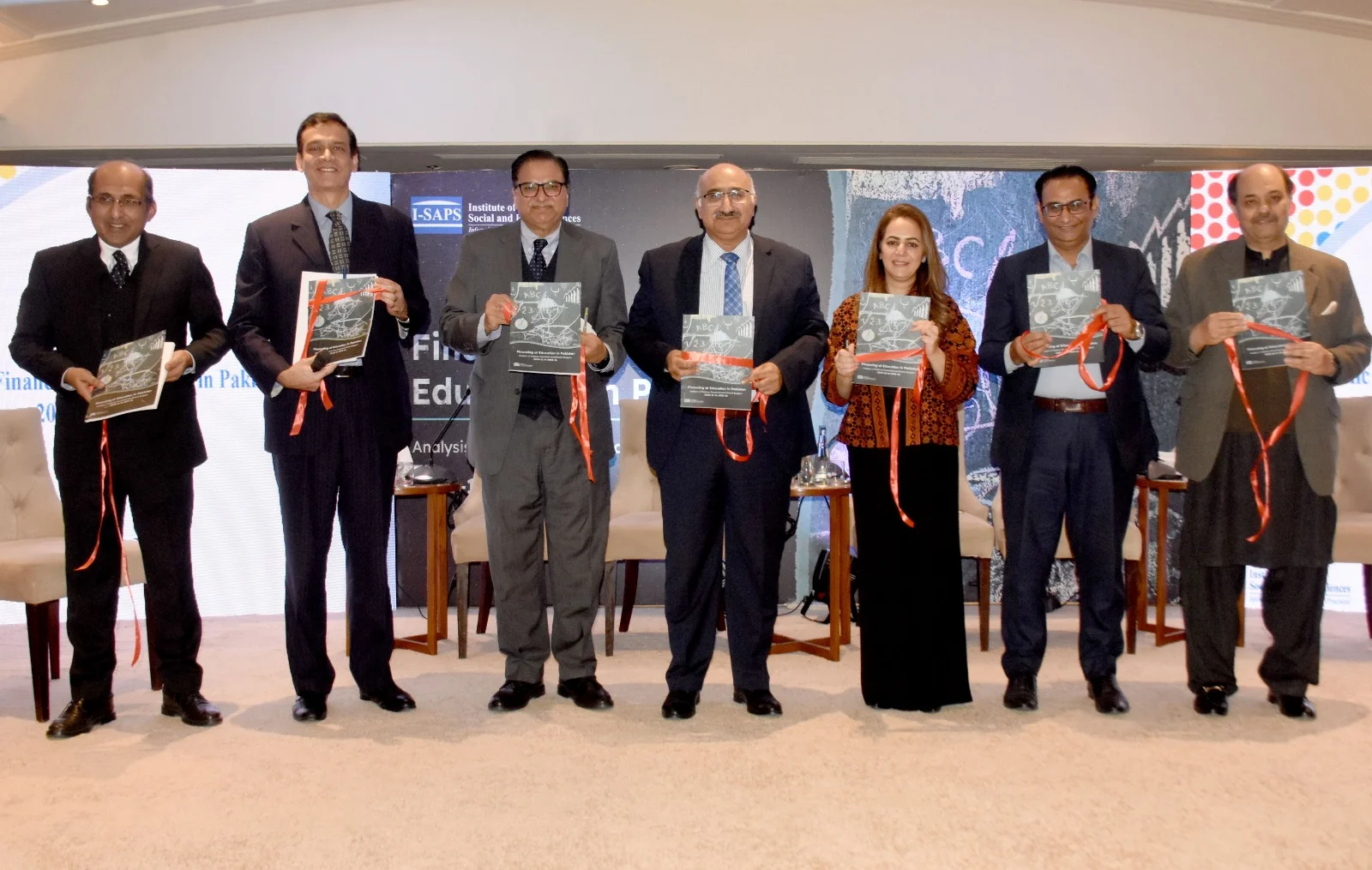
Pakistan’s education sector has reached a critical juncture as total spending on education climbed to Rs. 5.03 trillion, with households now contributing more than the government for the first time in the country’s history. The finding was revealed in the 15th annual report on Public Financing of Education launched by the Institute of Social and Policy Sciences (I-SAPS) at a National Policy Dialogue held here on Tuesday.
According to the report, household spending on education has surged to Rs. 2.8 trillion, surpassing public sector investment of Rs. 2.23 trillion. This marks a fundamental shift in Pakistan’s education financing landscape, raising serious concerns about equity, access, and the state’s ability to ensure quality education for all, especially as an estimated 25 million children remain out of school.
The I-SAPS report is the first comprehensive analysis in Pakistan to account for both public education budgets and household-level expenditures. It shows that while the public sector contributes 44 per cent of total education financing, the remaining 56 per cent is borne by families. Household spending includes Rs. 1.31 trillion on private school fees, Rs. 613 billion on shadow education and tuition, and Rs. 878 billion in other out-of-pocket costs such as books, uniforms, and transport.
“Families are financing education at a scale that raises fundamental equity concerns,” said Dr Salman Humayun, Executive Director of I-SAPS. He warned that when household spending exceeds public investment, the burden increasingly falls on those least able to afford it, deepening exclusion for poorer and marginalised communities.
Speakers at the policy dialogue highlighted that rising private spending reflects growing dissatisfaction with the public education system. Education Team Leader at the Foreign, Commonwealth and Development Office (FCDO), Mazhar Siraj, stressed the need to move away from input-heavy approaches and towards outcome-based financing and efficiency reforms, noting that innovation must be supported by strong governance and reliable data systems.
World Bank Senior Education Specialist Izzah Farrukh observed that the expansion of private schooling signals families opting out of public schools due to declining responsiveness and limited voice and agency. She said this trend underscores the urgency of rebuilding trust in public education.
Dr Shahid Soroya, Director General of the Pakistan Institute of Education, emphasised the importance of sustained evidence generation and acknowledged efforts by the federal ministry and development partners to strengthen annual education data consolidation.
Former federal secretary for finance and health, Hamed Yaqoob Sheikh, praised I-SAPS for providing analytical frameworks that enable informed resource allocation across social sectors, particularly in a fiscally constrained environment.
Concluding the dialogue, Ahmad Ali, Director Programmes at I-SAPS, said rising private spending should be treated as a policy signal. He called for strengthening public systems, improving efficiency in the use of existing resources, and developing financing models that protect equity, especially for girls and marginalised learners.
Participants agreed that education financing in Pakistan stands at a turning point. Decisions taken in upcoming budget cycles will determine whether increased spending translates into better learning outcomes or further entrenches inequality.