Pakistan lacks resilience against terrorism despite heavy losses, says Mohsin Abbas
Javed Khan
PESHAWAR
Speakers at a provincial dialogue called for stronger coordination among state institutions, lawmakers and civil society to strengthen counterterrorism efforts and prevent violent extremism in Khyber Pakhtunkhwa.
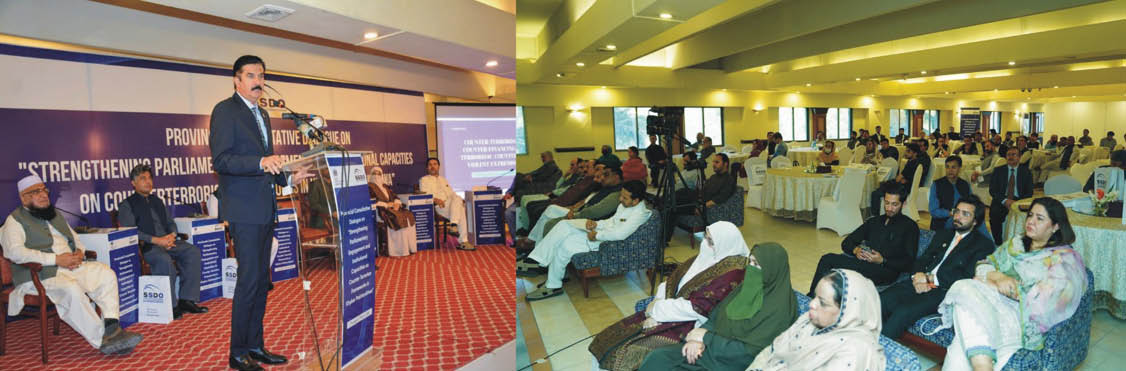
The dialogue, described by organisers as the first initiative of its kind in the province bringing together all major stakeholders on counterterrorism, was organised by the Sustainable Social Development Organization (SSDO) with the support of the British High Commission at a hotel in Peshawar.
Faisal Karim Kundi, Governor KP attended the event as chief guest.
The event brought together parliamentarians, government officials, law enforcement representatives, academics and members of civil society to deliberate on strengthening mechanisms related to counterterrorism, countering financing of terrorism and preventing violent extremism.
Speaking at the opening session, Syed Kausar Abbas, executive director of SSDO, said sustained engagement between policymakers, practitioners and oversight institutions was essential for strengthening Pakistan’s response to evolving security challenges.
He said improved coordination, informed policymaking and stronger legislative engagement could play a key role in addressing terrorism and extremism.
He added that the provincial consultation was part of a broader initiative aimed at promoting policy dialogue and institutional coordination on counterterrorism and counter-extremism.
Earlier in February, he said, SSDO organised a two-day national dialogue in Islamabad bringing together federal and provincial stakeholders to discuss parliamentary engagement and institutional capacities for countering terrorism.
Participants also shed lights on existing counterterrorism frameworks and legislation and discussed ways to improve institutional capacity, information-sharing and policy implementation.
Experts stressed the importance of evidence-based policymaking and effective parliamentary committees to oversee security-related legislation.
During the session, senior legislative expert Mohsin Abbas Syed presented an overview of the country’s national and provincial counterterrorism and countering financing of terrorism frameworks and law enacted in different governments both at provincial and national levels.
He highlighted existing legal and institutional arrangements, coordination mechanisms among agencies and the role of provincial governments in implementing counterterrorism policies.
He said the National Action Plan (NAP) included both enforcement measures against militant groups and preventive steps such as reforms in seminaries and the education curriculum. He also pointed to the need to strengthen the country’s resilience against terrorism.
A panel discussion featuring representatives from the KP Home Department, academia, the National Counter Terrorism Authority (NCTA) and the Centre of Excellence on Countering Violent Extremism discussed strategies for improving coordination on countering violent extremism initiatives in the province.
Another panel discussion was focused on the role of parliamentarians in supporting law enforcement institutions in tackling terrorism and violent extremism. Participants emphasised that lawmakers could play an important role through legislative oversight, effective functioning of standing committees and policy reforms.
During the discussion, Asif Khan Mehsud of the Pakistan Tehreek-e-Insaf (PTI) said all state institutions needed to work in close coordination to eliminate terrorism. He noted that terrorism and its financing had become global challenges and stressed the need to guide youth in the right direction to prevent radicalisation.
Amna Sardar of the Pakistan Muslim League Nawaz (PML-N) highlighted the importance of the provincial assembly’s committee system and proposed the establishment of a dedicated research wing to support lawmakers in policymaking. She said lawmakers, being in direct contact with the public, could play a key role in addressing social challenges and emphasised the need for cooperation between the government and opposition to ensure lasting peace.
Representing the Awami National Party (ANP) Babir Khan Yousifzai said KP had been at the forefront of the fight against terrorism for decades and had suffered significant human and economic losses.
He appreciated SSDO for organising the dialogue and called for implementing the National Action Plan in letter and spirit.
Provincial spokesperson of Jamiat Ulema-e-Islam Fazal (JUI-F) Jalil Jan also highlighted the role of religious parties and stressed the need for stronger coordination among all stakeholders to maintain peace in the country.
In his concluding remarks, Faisal Karim Kundi, governor of KP, emphasised the importance of collective action, institutional coordination and democratic oversight in strengthening the country’s response to terrorism and violent extremism.
He appreciated SSDO for organising the consultative session and urged the government to ensure the participation of civil society in efforts to eliminate terrorism. He said politicians across the country had suffered the consequences of terrorism and shared a collective commitment to creating a peaceful environment conducive to development.
Participants agreed on the need for stronger cooperation among institutions, improved legislative oversight and greater investment in preventive measures to address the root causes of violent extremism.
Later, the Governor Kundi distributed shields among participants in recognition of their contributions to the dialogue.