Digri
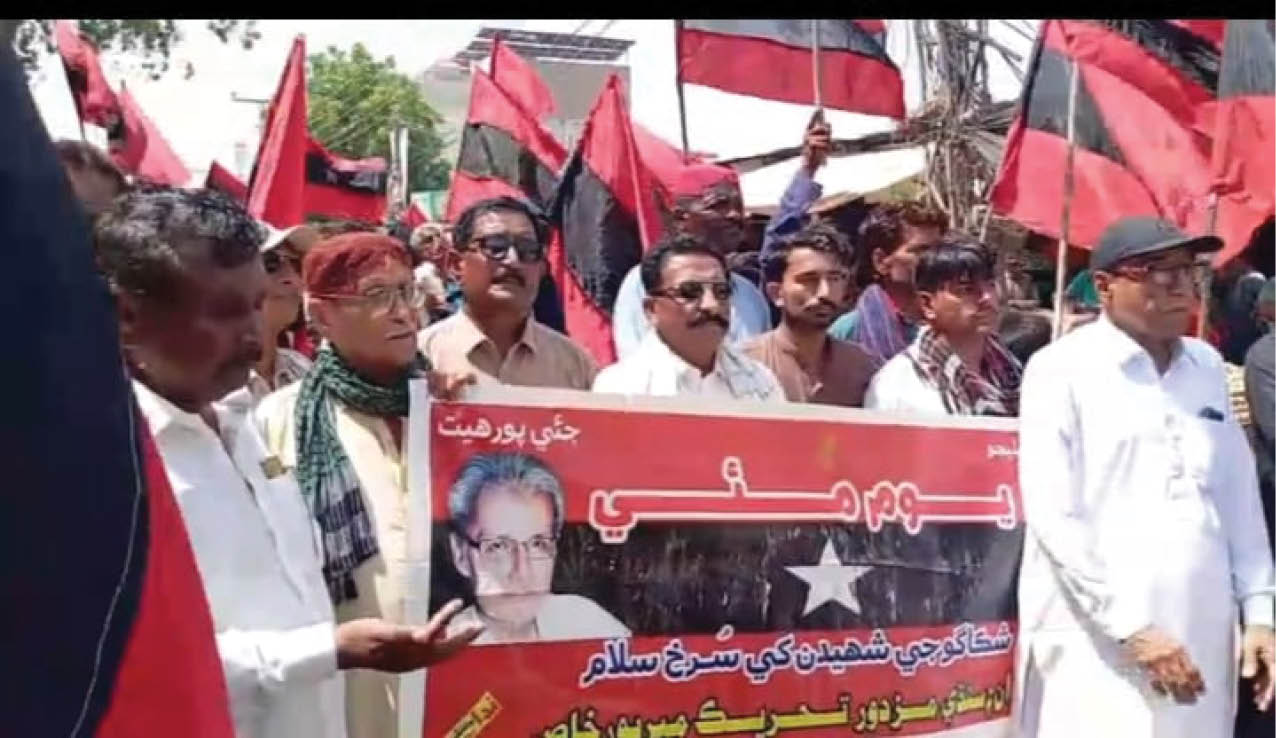
A protest demonstration was held in Digri on the occasion of International Workers’ Day by the Sindhi Mazdoor Tehreek. The protest was led by central secretary Muhammad Ali Khaskheli, Talib Jarwar, Mama Ashraf Rind, Mahmood Bhambhro, Dr. Dildar Laghari, Ayaz Kaloi, Mukhtiar Khaskheli, Ayaz Khoso, Amir Bux Jarwar, A.B. Jarwar, Razaq Baloch, and others.
Addressing the gathering, central and district leaders of Sindhi Mazdoor Tehreek and Awami Tehreek said that May Day is recognized in the name of the martyrs of Chicago. They stated that oppressive capitalists and their puppet rulers stained the peaceful protest of workers with blood, giving workers the awareness that their struggle would only succeed after sacrifices.
The leaders said that the wheel of global progress runs on the labor and blood of workers. While farmers feed over eight billion people in the world, workers’ homes remain in darkness and farmers’ children go hungry. Today, workers and peasants are forced to live in extreme poverty. Whenever a crisis emerges globally, the worst affected are workers, peasants, laborers, street vendors, and small shopkeepers. They further said that over the past twenty years in Pakistan, the condition of the lower class has significantly deteriorated.
The reason behind this is the control of capitalists and traders over the means of production as well as legislative assemblies. Annual human rights reports indicate that there has been no real increase in workers’ wages. Over the past two decades, daily wages have only increased from five hundred rupees eight hundred rupees. The leaders added that workers in Sindh have deliberately been pushed into hunger and deprivation. Due to flawed government policies, workers have been deprived of their employment rights.
According to the constitution and law, workers are not even paid the minimum wages. On the other hand, through corporate farming, the government is attempting to take away the resources, livelihoods, and lands of agricultural workers. They demanded that workers be given their basic rights and that the privatization of national institutions be immediately stopped.
The leaders also called for an end to artificial inflation, an increase in wages for workers and craftsmen, establishment of industries at the local level, employment opportunities for Sindhi people in industries, issuance of health cards to workers, financial support for injured workers during duty, reopening of closed industries, technical training programs at the union council level, and practical steps to increase daily wages to two thousand rupees. A large number of local workers participated in the gathering.