Najm us Saqib
In international relations, nations strive to cope with a complex and ever-shifting geopolitical landscape. A true strategic shift, being a profound undertaking, is a fundamental reorientation of a state’s core policy — born not from whim, but from the crucible of crisis or the clear anticipation of one. Such shifts are often painful and expensive, yet states are at times compelled to undertake them to redefine their nation’s future trajectory. For instance, America’s deliberate rebalancing of diplomatic, economic, and military attention towards the Asia-Pacific is a direct response to China’s rapid ascent.
The United Kingdom is attempting to redefine its role in the world by deprioritising the European neighbourhood and seeking enhanced ties with partners in the Asia-Pacific. Russia is moving towards an openly confrontational and revisionist stance aimed at challenging the US-led international order and reasserting a sphere of influence. Similarly, Germany’s Energiewende, accelerated by the war in Ukraine, represents a strategic shift in energy security and economic policy, phasing out nuclear power while eliminating dependency on Russian fossil fuels.
It is within this context of global recalibration that the recently concluded Strategic Mutual Defence Agreement (SMDA) between Saudi Arabia and Pakistan needs to be viewed. This pact aims to develop defence cooperation and strengthen joint deterrence against any aggression. Accordingly, any aggression against either country shall be considered an aggression against both. The deal represents a strategic shift in its purest form — a potential watershed moment with ramifications that could alter the balance of power in the Middle East and beyond. The current geopolitical climate has injected a new sense of urgency. Therefore, to dismiss it as merely an extension of long-standing bilateral ties would be a critical error.
The pact’s announcement immediately ignited a flurry of geopolitical speculation. How will this agreement recalibrate the regional balance of power in favour of these two significant Muslim nations? Should traditional powers like the US and Europe be wary of a united front with potent military dimensions? The most consequential concern, however, revolved around the nuclear question: will Pakistan’s nuclear umbrella be extended to Saudi Arabia as an implicit or explicit guarantee? This prospect alone sends ripples across the globe, prompting adversaries like Israel and India to consider the necessity of a countervailing alliance. Furthermore, how will the pact calculate the delicate equation of support as Pakistan possesses impressive military credentials and a battle-hardened army, while Saudi Arabia wields vast economic power? The synergy is clear. However, the dynamics are complex, especially when one partner faces existential security threats and the other seeks to secure its economic transformation.
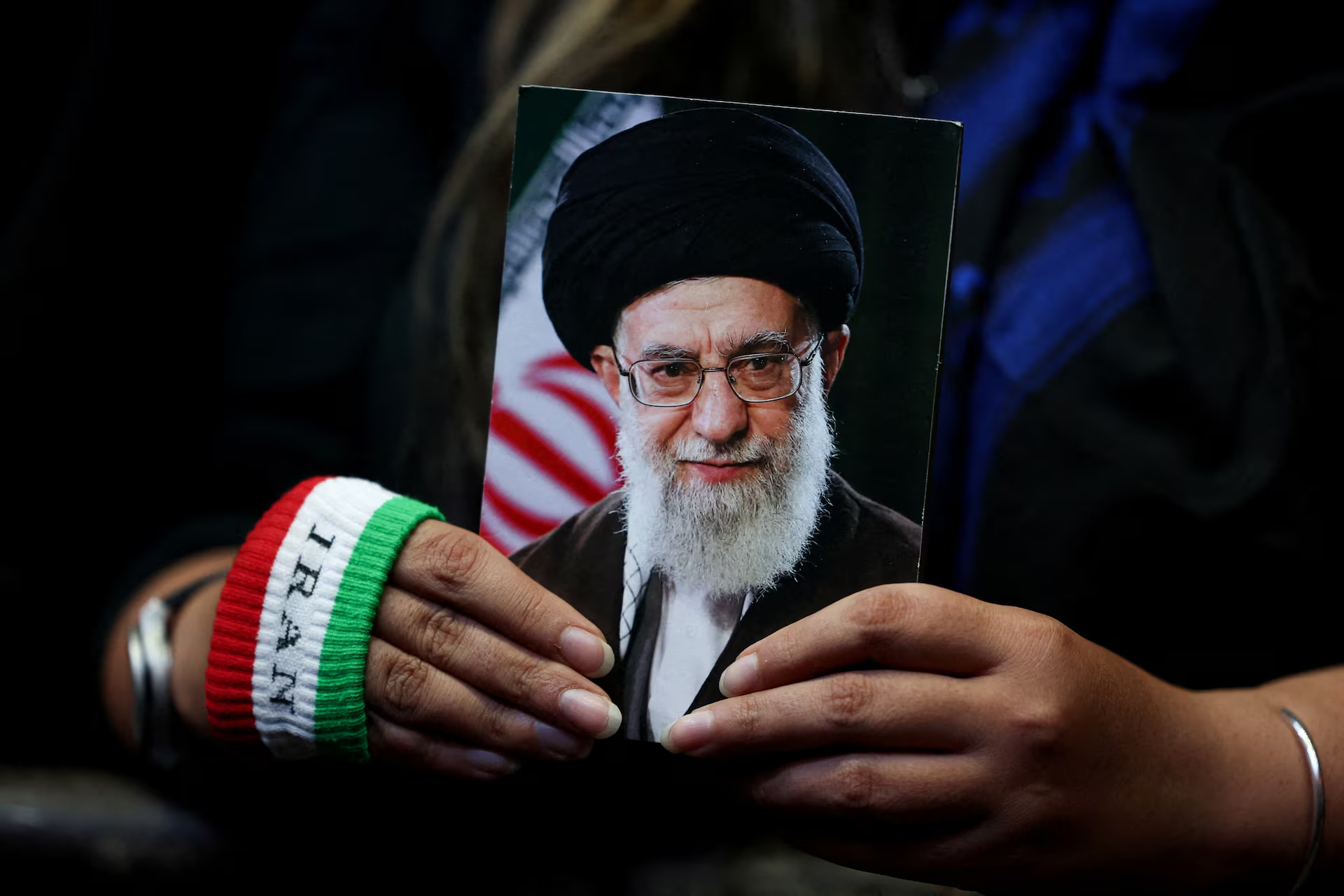
Iran’s positive response to the pact is indeed intriguing, considering its status as a key regional actor and an adversary of both the United States and Saudi Arabia.
To grasp the pact’s significance, one must look beyond the immediate headlines and understand the deep historical bedrock upon which it is built. This is not a sudden alignment of strangers but the formalisation of a relationship decades in the making. Pakistan’s security cooperation with the Kingdom dates to the 1960s, constituting a fundamental tenet of Pakistan’s foreign policy. This commitment was reiterated in Pakistan’s first-ever National Security Policy of 2022. The relationship has been symbiotic: Islamabad’s steadfast military support, including the dispatch of troops for training and defence, has been met with crucial economic assistance from Riyadh, such as regular debt rollovers and vital oil supply arrangements. While there have been brief hiccups, notably regarding the conflict in Yemen, the underlying cordiality and mutual dependence have remained resilient.
However, calling this new agreement a mere continuation of foreign policy would be an understatement. From Riyadh’s perspective, a region in flux presents clear and existential dangers. The Arab Spring’s aftermath, the ongoing conflict in Gaza, and the perceived unpredictability of traditional security guarantees have likely catalysed a search for a more reliable and trusted partner. For Saudi Arabia, Pakistan’s proven defence capabilities, honed through decades of counter-terrorism operations and technologically savvy conventional military readiness, present a compelling solution to its security dilemmas.
For Pakistan, grappling with a precarious economic situation and persistent internal security challenges, the pact offers a strategic anchor. It solidifies a relationship with a powerful economic benefactor, potentially ensuring long-term financial stability and a stronger diplomatic position vis-à-vis its primary adversary, India. By elevating its partnership with Riyadh to a formal alliance level, Islamabad projects itself as a net stabiliser and a key security provider in the region, enhancing its strategic autonomy, even as it maintains its ‘all-weather’ friendship with China.
In essence, the pact is a classic example of strong strategic posturing. It signals a fundamental change in the long-term direction and core approach of both states. For Pakistan, it is a ‘High-Risk, High-Reward’ grand strategy aimed at securing its national interests — survival and growth. The risks are substantial, as a poorly executed alliance based on flawed assumptions could entangle it in conflicts beyond its borders or provoke a destabilising reaction from opposing powers. For Saudi Arabia, it is a bold move to diversify its security portfolio beyond its traditionally heavy reliance on the United States, a relationship that has grown increasingly complicated, particularly after the recent attack on Qatar.
Both Saudi Arabia and Pakistan must treat this development with the seriousness it demands. The talk of a ‘nuclear umbrella for the entire Ummah’ is incendiary and must not be encouraged, as it threatens to provoke a dangerous regional arms race. In doing so, Pakistan would be making another strategic policy shift from its earlier assurance that its nuclear capability was developed as a deterrent against India. While the sands of the Middle East are shifting, the pact must serve its stated purpose of enhancing mutual security — without making major powers nervous to the point of direct intervention.
The writer is a former Ambassador of Pakistan and author of eight books in three languages. He can be reached at najmussaqib1960@msn.com
Courtesy