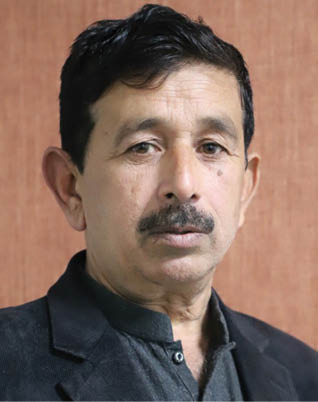
Awais Hameed
It wasn’t long before Indian Prime Minister Narendra Modi threatened to isolate Pakistan in the international community. Ever since Narendra Modi came into power, his government has been flexing its muscles needlessly. This over confidence of economic and military might has created an illusion in India of being the leader of the region. That’s the exact reason behind India’s declining relations with all its neighbors. In the recent past, countries like Maldives, Bhutan, Nepal, Sri Lanka and Bangladesh were often seen as India’s allies. The Modi government’s aggressive policies have caused a gulf of differences with its regional allies and isolated it in the region. China’s well-thought-out strategy has pushed the SAARC countries away from India and closer to China.
China has a 22,457-kilometer border with 14 countries, but it has border disputes only with India and Bhutan. The 3,488 kilometers long Indian border with China, from Arunachal Pradesh to Ladakh, is a constant cause of strained relations between both these countries. They fought a war over the border dispute in 1962. India faced a humiliating defeat and China occupied a large part of the disputed area.
China also claims many areas of the Indian state of Arunachal Pradesh as its part and calls it Xingnan. Recently, China has renamed 27 places in Xingnan after Chinese names. China believes that Arunachal Pradesh is the southern part of Tibet. The Western bloc, especially the United States, considers India to be an important power against China. Western countries have been investing in India for many years. After Rafale jets, India is now eyeing F-35 jets from the US. In addition, India is also part of the Quad, a four-nation alliance formed against China. It includes India, the US, Japan and Australia.
The Modi government’s relations with Bangladesh have also become extremely tense. India is trying to build a fence on the Bangladeshi border. The Bangladeshi government considers the fence illegal causing a new conflict between the two countries. Both countries have already locked horns on the repatriation of the former prime minister Sheikh Hasina. She was a valuable asset to India. The interim government of Bangladesh has been continuously demanding that India hand over Sheikh Hasina.
The ongoing tension between the two countries over Hasina Wajid and the border disputes has reached the point of trade restrictions. First, India suddenly imposed a ban on Bangladeshi trade through its airports and ports. In response, Bangladesh restricted the import of cotton yarn from India by land route.
On April 30, 2023, Hasina Wajid allowed India to use the seaports of Chittagong and Mongla. This access provided India great ease in transporting goods to its 7 northeastern states. With this, the Chittagong Port became connected to Haldia Port in West Bengal. India got easy access to its northeastern states by sea. There are voices from Bangladesh to cancel this permission.
Bangladesh Chief Executive Muhammad Yunus visited China in March. In a meeting with President Xi Jinping, he offered China to join the conservation project of the Teesta River near Chicken Neck, the narrow strip connecting northeastern Indian states to mainland. This offer has also raised concerns in India.
India also has a border dispute with its old ally Nepal. On June 13, 2020, the Nepalese parliament approved a new map of the country that included three areas along the Indian border. India claimed that these three areas were part of the Indian land. Nepal also issued a new 100 rupee note with this new map last year. India was once again outraged.
India’s relations with Bhutan have been exemplary, but the Modi government has created tension with Bhutan as well. Bhutan, China and India’s borders meet in the Doklam region. After the 2017 China-India stand-off, Bhutan changed its position. Bhutan recongnized China as a party to this dispute. This change in policy did not please India because Doklam and the surrounding area are of utmost importance to India.
India’s relations with Myanmar, another neighboring country, have also deteriorated in recent times. Relations between the two countries began to deteriorate after the military junta’s coup in 2021. When large-scale persecution of Muslims began in Myanmar, thousands of Rohingya Muslims migrated to India. Recently, multiple reports revealed that India had captured dozens of Rohingya refugees and thrown them into the open sea.
The Modi government terminated the free movement regime with Myanmar last year, which allowed Myanmar citizens to travel within 16 kilometers of India without a visa. India also alleges that Myanmar is a safe haven for insurgents who carry out attacks in Manipur, Mizoram and Nagaland.
India’s relations with Sri Lanka have never been ideal because of India’s support for the Tamil rebels. India had been providing covert political, financial and military support to the Tamil rebels. According to Sri Lankan media reports, from 1983 to 2009, the Indian intelligence agency RAW provided military training and weapons to 20,000 Tamil rebels. It is said that Kalvin Rajaratnam, who carried out a suicide attack on Rajiv Gandhi on May 21, 1991, was also raped by Indian soldiers. Narindra Modi has also started a diplomatic battle to take back an island from Sri Lanka. This island, called Kachatheevu, is about two kilometers long and is located in the Palk Strait between India and Sri Lanka. India had relinquished its claim to the island in 1974. Narendra Modi, during his election campaign, started a diplomatic war with Sri Lanka by promising to retrieve the island. The smallest country in the region, Maldives, has also joined the Chinese camp. In the 2023 presidential election, Mohamed Muizzu contested with the promise to cement relations with China instead of India. His opponent, Ibrahim Mohamed Solih raised the slogan of ‘India First’. Mohamed Muizzo won the election. He ordered the Indian troops present in the country to leave. Moreover, China has included the Maldives in its Belt and Road Initiative.
Modi’s ambitious endeavor to isolate Pakistan has culminated in India’s complete isolation in the region. His extremist policies have intensified India’s conflicts with all its neighboring countries. On the other hand, the number of countries standing with Pakistan is increasing. If the Modi government does not get rid of the extremist ideology of Hindutva, the future will bring more adversities for India.
The writer is Controller News at 365 News and can be reached at awais711@gmail.com